

The Church Calendar
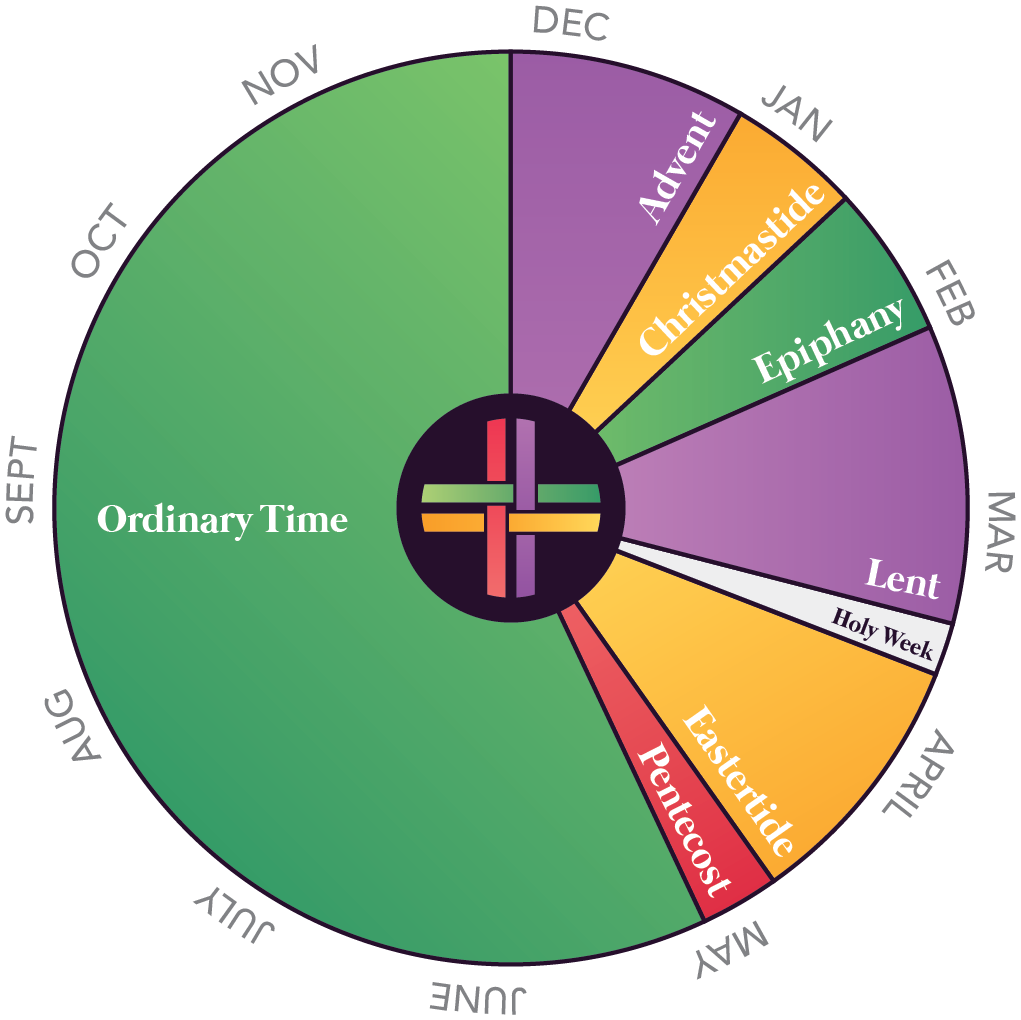
The Seasons of the Church Year
The Church year is an ancient way Christians mark time, not simply to remember the life of Jesus, but to be formed by it. Rather than following the calendar of the world, the Church follows the story of redemption, walking year after year through Christ’s coming, ministry, death, resurrection, the gift of the Holy Spirit, and the lifelong work of discipleship. Each season invites us to linger over a different aspect of the Gospel, shaping our hearts through rhythms of waiting, celebrating, repenting, and growing.
Advent
Advent is the first season of the Church year, a season of waiting, watching, and hopeful expectation as we prepare to celebrate Christ’s first coming while longing for his return. The color is purple, representing royalty and the coming king. Each week, another candle is lit on the Advent wreath, its growing light reminding us that Christ, the Light of the World, is drawing near. Traditionally, the four candles represent Hope, Peace, Joy, and Love: gifts Christ brings to a world still longing for redemption. Advent teaches us that waiting is not wasted time, but a spiritual discipline that forms our hearts to trust the God who comes faithfully, bringing light into darkness and mercy into a world still waiting to be made new.
Christmastide
Christmastide is the joyful season in which the Church celebrates the mystery of the Incarnation: that the eternal Son of God took on human flesh and dwelt among us. Rather than ending on December 25, Christmas unfolds over twelve days, inviting us to linger in the wonder that God entered his creation to bring light into darkness and life to the world. In Jesus, heaven and earth meet. Christmastide reminds us that God is not distant, but Emmanuel, “God with us,” and that his coming changes not only one day in history, but the whole story of humanity.
Epiphany
Epiphany celebrates the revealing of Jesus Christ to the world. Beginning with the visit of the Magi, the Church remembers that Christ came not only for Israel, but for every nation and every people. Drawn by a light they did not fully understand, the Magi recognized the King whom many others overlooked, reminding us that God often reveals himself in unexpected ways and to unexpected people. Epiphany is a season of unveiling, inviting us to see Jesus more clearly and to allow his light to expose both the darkness around us and the places in our own hearts that still need his transforming grace.
Ash Wednesday
Ash Wednesday marks the beginning of Lent, a forty-day journey of repentance, prayer, and preparation for Easter. As ashes are placed on our foreheads with the words, “Remember that you are dust, and to dust you shall return,” we are reminded of both our mortality and our need for God’s mercy. Yet Ash Wednesday is not a day of despair. It is an invitation to honesty, humility, and hope, calling us to turn away from sin and return to the God who delights to forgive, restore, and make all things new.
Lent
Lent is a forty-day season of repentance, prayer, fasting, and preparation for Easter. Marked by the color purple, it calls us to humility, self-examination, and renewed dependence on God’s grace. Following Jesus into the wilderness, we set aside distractions and turn our hearts toward him, remembering that true freedom is found not in self-denial alone, but in the God who delights to forgive, restore, and make all things new.
Palm Sunday
Palm Sunday begins Holy Week by remembering Jesus’ triumphal entry into Jerusalem. As crowds welcomed him with palm branches and cried, “Hosanna!” they hailed him as the long-awaited King, though few understood the kind of kingdom he came to establish. Marked by the color red, this day invites us to rejoice in Christ’s kingship while preparing our hearts to follow him from celebration to the cross.
Maundy Thursday
Maundy Thursday remembers Jesus’ final meal with his disciples before the cross. On this night, he washed their feet in humble love, instituted the Lord’s Supper, and gave a new commandment: “Love one another as I have loved you.” The word maundy comes from the Latin mandatum, meaning “command.” This solemn feast invites us to receive Christ’s love and to imitate it through lives of humble service and self-giving.
Good Friday
Good Friday remembers the crucifixion of Jesus Christ. It is a solemn pause in the story of redemption, inviting us to stand in the shadow of the cross and behold the depth of God’s love. Jesus, innocent and full of mercy, willingly gave himself for the life of the world. The Church does not rush past this day, because only by lingering at the cross do we fully understand the joy of the resurrection.
Resurrection Sunday
Resurrection Sunday is the great feast of the Christian faith. The Church gathers to proclaim the unthinkable: Christ is risen. Death has been defeated, sin has been conquered, and the tomb is empty. More than remembering a moment in history, we celebrate the living hope of the resurrection and the promise that all who belong to Christ will share in his victory.
Eastertide
Eastertide is the fifty-day season of celebrating Christ’s resurrection, from Easter Sunday to Pentecost. Marked by the colors white and gold, the Church rejoices that death has been defeated and new creation has begun. Eastertide reminds us that the resurrection is not merely something Christ experienced, but the new life he now shares with his people, calling us to live as people transformed by his victory.
Pentecost
Pentecost celebrates the outpouring of the Holy Spirit upon the Church, fifty days after Easter. Marked by the color red, symbolizing the fire of the Spirit, this feast remembers the fulfillment of Christ’s promise to send his Spirit to empower, guide, and sustain his people. Pentecost reminds us that the Church is not sustained by human strength, but by the living presence of God working through ordinary people for the sake of the world.
Trinity Sunday
Trinity Sunday celebrates the mystery at the heart of the Christian faith: one God eternally existing as Father, Son, and Holy Spirit. Rather than commemorating a single event, this feast invites us to marvel at the God who has revealed himself as perfect love and eternal communion. Marked by the color white, Trinity Sunday reminds us that every act of worship, mission, and discipleship flows from the life of the triune God, who invites us into fellowship with himself.
Ordinary Time
While its name may sound uneventful, Ordinary Time is anything but ordinary. It is the long, green season of the Church year devoted to spiritual growth and faithful discipleship. Rather than focusing on a single event in the life of Christ, this season invites us to live out all that has come before through the ordinary rhythms of prayer, worship, work, rest, repentance, service, and love. Marked by the color green, Ordinary Time reminds us that God often does his deepest work slowly, patiently shaping us into the likeness of Christ one faithful day at a time.
All Saints’ Sunday
All Saints’ Sunday celebrates the faithful men and women who have gone before us in Christ. Not only the well-known saints of history, but also the ordinary believers whose lives quietly pointed others to Jesus. Rooted in the early Church’s remembrance of the martyrs, this feast has grown into a celebration of the “great cloud of witnesses” who encourage us as we run our own race of faith. As we give thanks for their lives, we are reminded that we belong to one Church across every generation, united in Christ.
Christ the King
Christ the King Sunday concludes the Church year by proclaiming that Jesus reigns over every nation, every power, and every age. First established in 1925 as a response to rising nationalism and political idolatry, this feast declares that no earthly kingdom or ruler has the final word. The Christian story ends where our hope ultimately rests: with the crucified and risen King, whose kingdom will never end.